



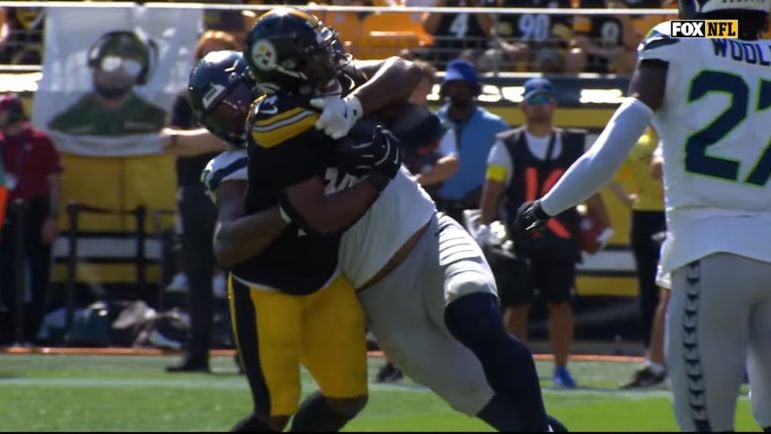
The Pittsburgh Steelers’ rushing attack has been discouraging to begin the 2025 season. The goal of this article is to provide some stat context for what has occurred in the first two games and see how it compares to the rest of the league.
First, I wanted to look at rushing on a team level, providing several data point ranks:
Far from a rosy picture, no doubt. Pittsburgh certainly wants to run the ball under HC Mike Tomlin and OC Arthur Smith. But seeing so many poor ranks really points to how much of a struggle it has been. The Steelers rank as a bottom-three team in attempts, yards, yards per attempt (YPA), yards before contact, and ten-plus runs.
These are crucial elements to a successful rushing offense. Instead, Pittsburgh has been one of the worst in the NFL in overall volume and quality. Running backs are, of course, the main source of rushing stats, but yards before contact also determine how well an offensive line is creating space. This has definitely limited the Steelers’ run game in several ways, and it must improve.
The majority of other ranks aren’t much better. Several other stats have bottom ten ranks: rushing touchdowns (1-of-6 teams with none), a long of just 13 (their only ten-plus run), EPA (expected points added), first downs, first and second down EPA, first half EPA, along with yards before and after contact. Largely, however you slice it, things have been excruciating for the Steelers’ rushing attack.
This leaves only three other stats I delved into. Two of them are below-average league ranks: second-half EPA (20th) and success rate (22nd). Of course, improvements need to be made here, too, but the essential stats could be worse. Being soundly below average in all but one metric has been painful, and it must change with how Pittsburgh wants to play.
Clearly, the best ranking by far is third-down EPA, landing third in the NFL. While that is a great stat to fare so well in, it’s a small sample size in a young season. Quality is always the choice over quantity, though, and Pittsburgh’s third-down EPA is the only silver lining among these stats. Changing this narrative is paramount.
I also wanted to look at things from a player perspective, so here is a similar chart for Steelers running backs Jaylen Warren and Kenneth Gainwell, with numbers and ranks compared to their peers. Most rankings are a minimum of ten rush attempts, except for down and half stats (all RBs):
Largely, we can see that Warren has provided better quality. The exceptions where Gainwell has better marks start with the team’s one ten-plus run of 13 yards, and hopefully, Warren starts producing in that regard. The other two stats that Gainwell ranks stronger are second-down EPA and yards after contact.
Yes, it’s a small sample size of just two games we’re going off of, but I didn’t expect the latter. Warren surely has that ability, as he demonstrated last game as a receiver, with a prime example 65-yard gain that’s the NFL’s longest catch to date. Time for the offense to provide chunk runs, a fantastic way to breathe life into a rushing attack.
Some of Warren’s most encouraging ranks include the team’s strong third-down EPA. He ranks tenth, rushing on all four of Pittsburgh’s attempts and picking up first downs on each. If the offense could get into manageable third downs more often, the opposition would have a much harder time than the too-often-pass situations on third and longs so far.
Warren has been strong in two other numbers: success rate and first downs. His 44.0-percent run success rate ranks 14th, and ties for 15th in moving the chains. Compared to Gainwell, the staggering difference is a lowly 16.7-percent success rate, landing near the bottom of qualifiers (min. ten runs).
I hope that improves, but it validates what our crew has said about Gainwell shining as a receiver much more than rushing. He has roughly half the rush attempts that Warren does, and some may say he gets more opportunities than others. But rookie Kaleb Johnson is in the doghouse for a bone-headed special teams mistake last game, potentially not dressing for Week Three, considering that was his main role (just two rushes in as many games).
The entire Steelers run game needs to step it up, no doubt, whoever is carrying the ball. Wish it were a different story, but the stat context illustrates some answers to who and what has been behind the struggles. And it’s a lot.