



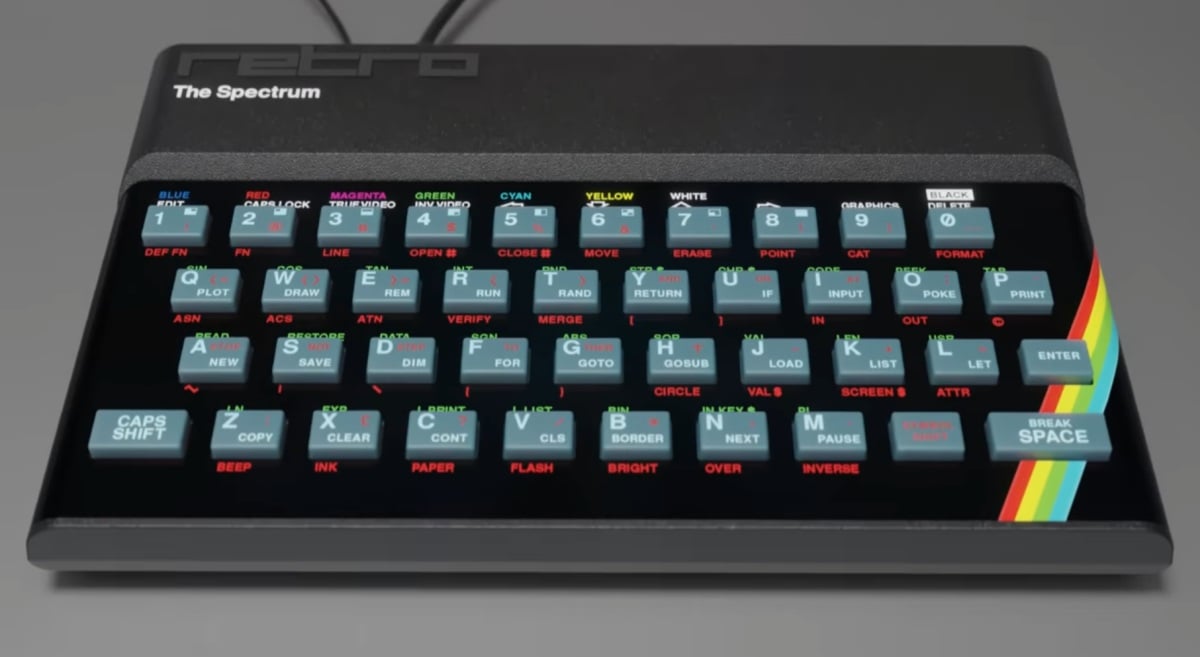
The Spectrum is an inexpensive home entertainment gadget from Retro Games Ltd (RGL) that’s hauntingly similar to a totally unrelated 1980s home entertainment device that was loved by millions.
The Spectrum is a very familiar black slab with blue-gray rubber keys. It plugs into your TV set and lets you play a wide variety of classic 1980s videogames – or, if you prefer, drop down to a BASIC interpreter and explore coding.
It’s exactly the same size and shape as an original Sinclair Research ZX Spectrum – to the extent that you can place Spectrum keyboard overlays over its squishy “dead flesh” type keyboard, for instance to help you remember the controls to a complex game such as Lords of Midnight by the late Mike Singleton. (You can still buy such things, remarkably.)
Youtube Video
Of course, it’s not really. It’s an Arm SBC, running Linux on an Allwinner H3 SoC, and on top of that, a customized Spectrum emulator running a third-party replacement ROM called TokenSE by Andrew Owen. It’s based on his earlier OpenSE BASIC, but with Spectrum-style single-press keyword entry.
This wasn’t the end of Owen’s input. The Spectrum also includes an implementation of his ULAplus, an improved ZX Spectrum graphics chip. This means it can run much more colorful games – some new, and some modified versions of classic ’80s titles. Note, though, that this doesn’t and can’t improve unmodified games. (If the idea of more colorful Spectrum games piques your interest, you can add ULAplus and an HDMI output to original Sinclair hardware with the external ZX-HD HDMI interface.)
The practical upshot of all this is that it’s not 100 percent compatible, but it’s very close, and it has better graphics than the real thing. It looks very like the original. In place of the Sinclair logo, the case molding says “Retro,” and instead of ZX Spectrum below that in white, it says “The Spectrum.” The box says 48, not because it has 48 kB of RAM – it has an order of magnitude more – but because it has 48 licensed games in its onboard flash.
Instead of the expansion connector, it has a row of USB ports. You can attach USB joysticks and gamepads to it, and you can connect a thumbdrive full of games, load and play them. You can even load an original Sinclair ROM image for better compatibility – Amstrad permitted non-commercial distribution, so this is legal, but RGL can’t sell it that way.
Amusingly, the new computer inside is so light that it would have slid across the tabletop as you typed, so it has some steel bricks bolted inside the case to make it as heavy as the original. It runs on USB-C power, but you need to bring your own power brick, such as a phone charger. It has an HDMI output and automatically upscales the Sinclair-style 256 x 192 output to 720p at the appropriate 4:3 aspect ratio.
It looks like a 48 but it isn’t – it can happily emulate a Spectrum 128 and play 128 games as well, with the much better 128-type sound, and they load in a second. It could happily emulate other things, but if you want that, RGL will sell you a miniature C64 – or for Atari fans, The400Mini. As we covered recently, an Amiga replica is coming next year.
The history of the device goes back to Chris Smith’s astonishing reverse-engineering of the Sinclair ULA, which resulted in his book The ZX Spectrum ULA: How to design a microcomputer, as well as a number of different Spectrum clones. We met Smith at the Vintage Computer Fair at Bletchley Park in 2010. This vulture played with the same Twitter-enabled ZX Spectrum you can see there.
That Speccy was online via a Spectranet ZX Spectrum Ethernet adaptor, and the creator of the Spectranet and the aforementioned Chris Smith are some of the minds behind RGL.
The reason that we’re writing about the machine now is that it’s back on sale for this year’s festive period from popular online outlets or physical toy shops. We weren’t sure it would be on sale earlier this year when we attended a talk on the creation of The Spectrum.
Retro Games opens pre-orders for THEA1200, a full-size working Amiga replica
AmiBrowser brings 21st century web to 20th century Amigas
Junk is the new punk: Why we’re falling back in love with retro tech
Christmas 1984: The last hurrah for 8-bit home computers
For us, it’s especially interesting because it works even though it doesn’t have any original Sinclair code in it. In 1986, Amstrad bought Sinclair. About a decade later, Sky bought Amstrad. Another decade later, Comcast bought Sky. This means that today, the Philadelphia-based giant owns the trademarks and IP of Sinclair Research, a little British outfit we suspect its board has never heard of, and no further licenses seem likely ever to happen.
Substantial effort went into The Spectrum to ensure games remain playable. The rubber keyboard matrix – which is made by an iPad keyboard manufacturer – has the same connectors as the original Sinclair one, although in different positions. It even replicates the original’s key ghosting quirk by presenting two separate USB keyboard devices.
“An absolute tonne of work” went into reducing the emulation latency from the typical 100 to 150 ms of a desktop emulator down to about 40 ms, and a UART on the USB daughterboard measures the response time from the TV set and compensates for it. Any original save-game functionality in the provided games has been removed: “If you understand assembly language, every program is open source.” Instead, the loader carousel lets you keep four snapshots. Sometimes this was especially tricky. The team used Skoolkit to trace the games’ code, but some things defeated them. For instance, The Spectrum comes with Football Manager 2 by Kevin Toms, who implemented the save-game functionality in Forth for cross-platform functionality, effectively preventing disassembly.
Any Reg reader should have no difficulty installing a ZX Spectrum emulator, downloading and loading a few games. Debian even provides a ROM. If you like to have your hands on hardware and want to dabble with an improved enhanced faster Spectrum, The Reg FOSS desk has a ZX Spectrum Next and it’s a fascinating thing to play with. But for a lot of former Spectrum gamers, that’s too much hard work for a bit of fun. They just want something that plugs into a TV and lets you play games in seconds, and for that, this gadget, available for £60 online, is ideal. ®