



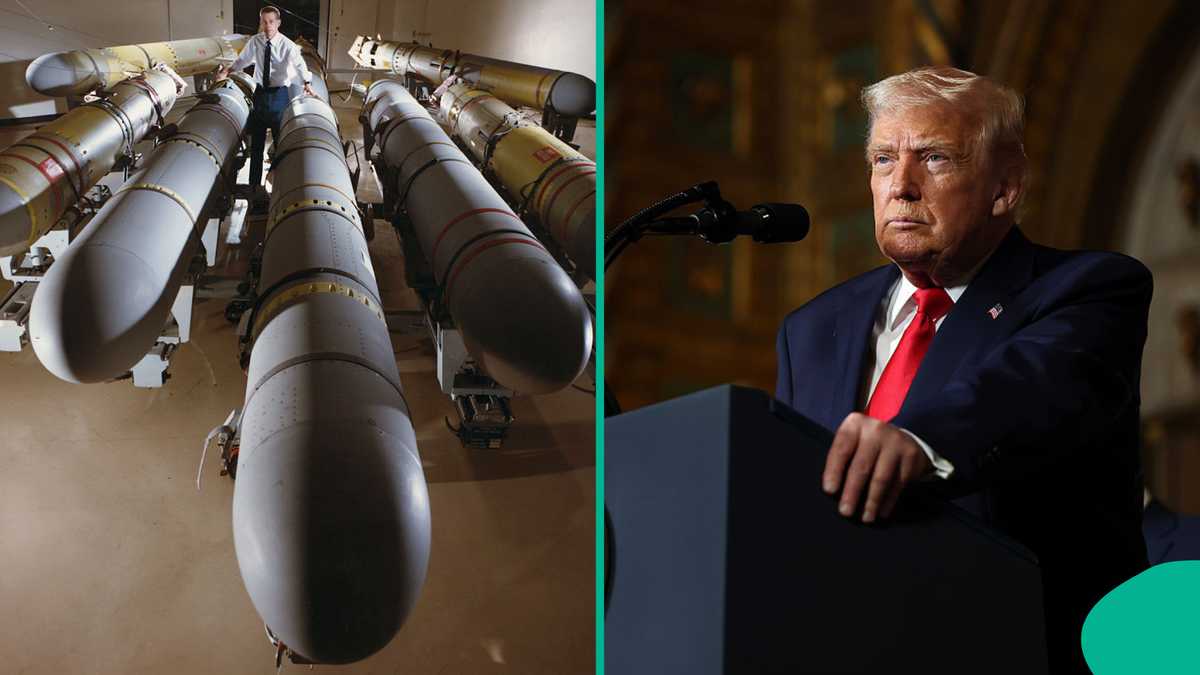
US air strikes in Sokoto reportedly involved the use of Tomahawk cruise missiles, a weapon long associated with American military operationsKnown for their precision and ability to evade detection, Tomahawks have played a central role in conflicts since the Persian Gulf War in 1991Their deployment in Nigeria depicted the missile’s enduring reputation as a strategic tool for long-range, high-risk strikesFollowing reports of US air strikes in Sokoto, Nigeria, attention turned to the Tomahawk missile, a weapon long associated with American military operations.
Here are key facts about the missile that was reportedly deployed.
US air strikes in Sokoto reportedly deployed Tomahawk cruise missiles, highlighting their precision and long-range strike capability. Photo credit: Bettman/x
Source: Getty ImagesTomahawk missile: American-made cruise weapon According to US Navy, the Tomahawk is an American-made, low-flying strategic guided missile. It may be launched from naval ships or submarines to strike targets on land.
Military analysts noted that it was designed to fly at low altitudes to hit fixed targets such as communication and air-defence sites, especially in high-risk environments where manned aircraft could be vulnerable to surface-to-air missiles.
Accuracy and range of Tomahawk missileAccording to Britannica, the Tomahawk is a long-range, unmanned weapon with an accuracy of about 5 metres (16 feet). Measuring 5.6 metres (18.4 feet) in length, it has a range of up to approximately 2,400 km (about 1,500 miles) and can travel at speeds of 885 km (550 miles) per hour.
Launch methods, ships and submarinesThe missile is launched vertically from ships, but it can also be fired horizontally from torpedo tubes on attack submarines or from external launchers attached to a submarine’s hull. During launch, it is powered by a solid propellant before switching to a turbofan engine that emits little heat, making infrared detection difficult.
Guidance system, TERCOM radarOnce over land, the Tomahawk uses inertial and terrain-contour-matching (TERCOM) radar guidance. A stored map on the missile’s computer is continually compared with the actual terrain to locate its position relative to the target. Analysts explained that the missile can twist and turn like a radar-evading fighter plane, skimming the landscape at altitudes of only 30–90 metres (100–300 feet).
Retasking and battle-damage assessmentMilitary planning often calls for Tomahawks to be used in the opening salvos of regional attacks to suppress enemy air operations. Reports stated that the missile could be retasked mid-flight, circling until human handlers selected another target. Its onboard cameras were also capable of transmitting battle-damage assessment data back to analysts.
Service history since 1983Submarine-launched Tomahawks entered service in 1983. They included conventional land-attack and antiship variants, as well as a nuclear warhead version that has since been retired. By the Persian Gulf War in 1991, Tomahawks had been fitted to surface ships.
First combat use in operation desert stormThe missile was first used in combat during Operation Desert Storm in January 1991. Reports confirmed that Tomahawks destroyed hardened targets such as surface-to-air missile sites, command-and-control centres, the Iraqi presidential palace in Baghdad, and electrical power plants. The war also marked the first coordinated strike involving Tomahawks and manned aircraft.
Global deployment of Tomahawk missilesSince 1991, Tomahawks have been used extensively in Iraq, Bosnia (1995), Libya (1996 and 2011), Sudan (1998), Yemen (2009), and Afghanistan (1998 and during the Afghanistan War beginning in 2001). More than 2,300 Tomahawks have been fired in combat operations, including during Operation Odyssey Dawn in Libya and Operation Inherent Resolve in Syria.
Modern variants, block IV and Block VThe Tomahawk Block IV, introduced in 2004, added the ability to reprogram the missile mid-flight via satellite communications. It could strike any of 15 pre-programmed alternate targets or redirect to GPS coordinates. The Block IV also loitered over target areas and transmitted battle damage information.
The latest Block V variant featured improved navigation and communications. Future upgrades included the Maritime Strike Tomahawk (Block Va) and the Joint Multiple Effects Warhead System (Block Vb).
Weapon of choice for US militaryMilitary sources described the Tomahawk as providing commanders with flexibility to attack long-range fixed targets or support Special Operations Forces. Its precision, responsiveness, and ability to evade detection made it the weapon of choice for the US Department of War.
Military analysts noted that Tomahawk Block IV and Block V variants enhanced in-flight targeting and navigation systems. Photo credit: VW pics/GettyImages
Source: Getty ImagesTerrorists relocate to new places after US air strikesLegit.ng earlier reported that there were indications that suspected terrorists in northern Nigeria had begun relocating following missile strikes carried out by the United States of America on the night of December 25.
Source: Legit.ng